
Feeding the AI Boom: Can data centers grow without burning more fossil fuels?
AI and cloud demand will double data center electricity use by 2030, from 415 to 945 TWh. Enviny's analysis: PUE optimization, FLAP-D geography shift, and behind-the-meter renewable strategies.
AI & DIGITALRENEWABLE
Pierre-Louis Lombard, Gregory Jarry
2/26/20266 min temps de lecture
Rapid digital growth — led by AI, cloud, and streaming — is set to double global data center electricity consumption by 2030. To meet this soaring demand, some operators are reverting to gas‑fired generation, as seen in xAI’s new turbine‑powered facilities, raising concerns over a fossil‑fuel rebound. Others are pursuing low‑carbon paths through renewable integration, advanced cooling, and behind‑the‑meter storage. This tension will define whether digital progress aligns or conflicts with global climate goals.
Bypassing environmental constraints to win AI’s race
Global demand for digital infrastructure is experiencing unprecedented growth, driven by three major forces: cloud adoption, streaming, and the rapid acceleration of generative AI. The race for AI dominance is so intense that some players are willing to bypass traditional constraints. A striking example is xAI’s Colossus mega-data center. Powered by roughly 400 MW of dedicated gas‑fired generation, it shows how competitive pressure can drive operators to pursue extreme measures to sidestep deployment delays — even when this means overriding environmental policies.
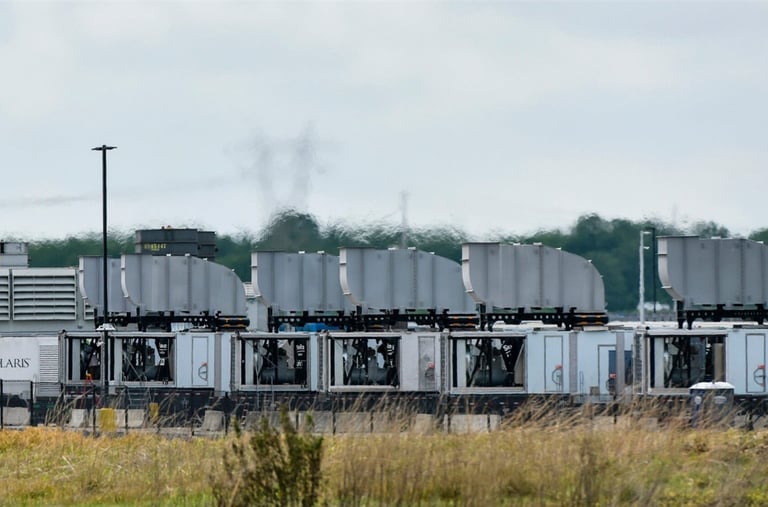

Gas turbines at the xAI data center in Memphis, Tenn. Credit: Brandon Dill/The Washington Post
Data center energy use will double by 2030 despite efficiency gains
Global electricity consumption from data centers, estimated at 415 TWh in 2025, is on track to exceed 945 TWh by 2030, more than doubling in just five years. This level of demand already represents an average of 4% of national electricity consumption in European countries, and can rise above 15% in Ireland, where data center concentration is particularly high.
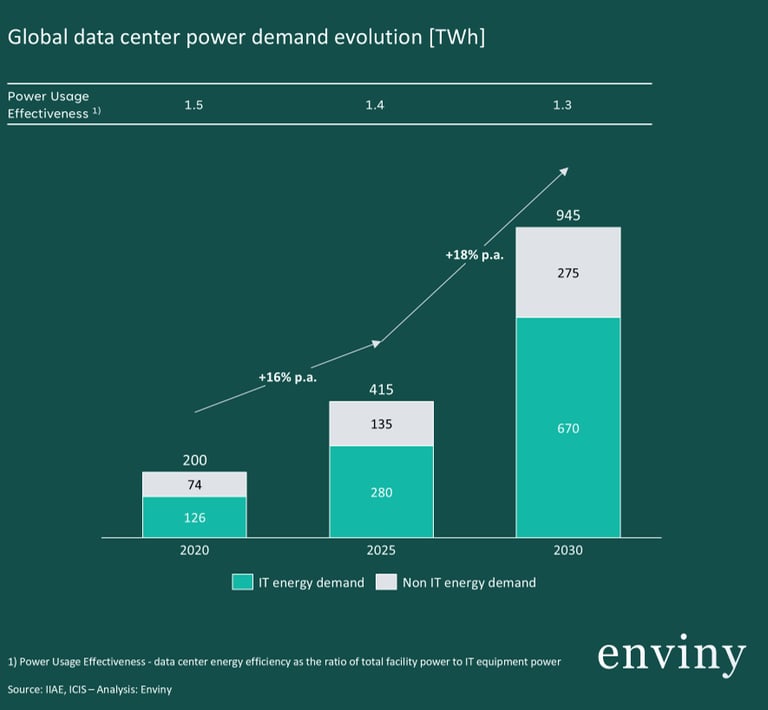
Five factors drive data center power consumption and determine overall efficiency:
Servers - Largest contributor to energy consumption in a data center, accounting for approximately 75% of total facility electricity use. CPUs handle orchestration and system logic, while GPUs deliver the high‑density compute required for AI training and inference.
Data Storage - Consumes around 5% of total electricity due to continuous power required to maintain data availability and integrity.
Network – Equipment such as switches, routers, and interconnects uses approximately 5% of a data center’s total power. These systems are essential to ensure fast, reliable, and secure data flows between servers, storage systems, and external networks.
Cooling - Second‑largest source of energy use. High‑density racks and GPU clusters generate significant heat, requiring chillers, air‑handling units, liquid cooling loops, or immersion cooling to maintain safe operating temperatures. Cooling typically represents around 10% of total energy consumption.
Other infrastructure - Auxiliary systems, including lighting, security cameras, access control, fire suppression, monitoring equipment, or general building operations, account for about 5% of energy use. This consumption is stable and required 24/7 to ensure continuous operation.
Targeting a factor-5 reduction in non‑server energy use
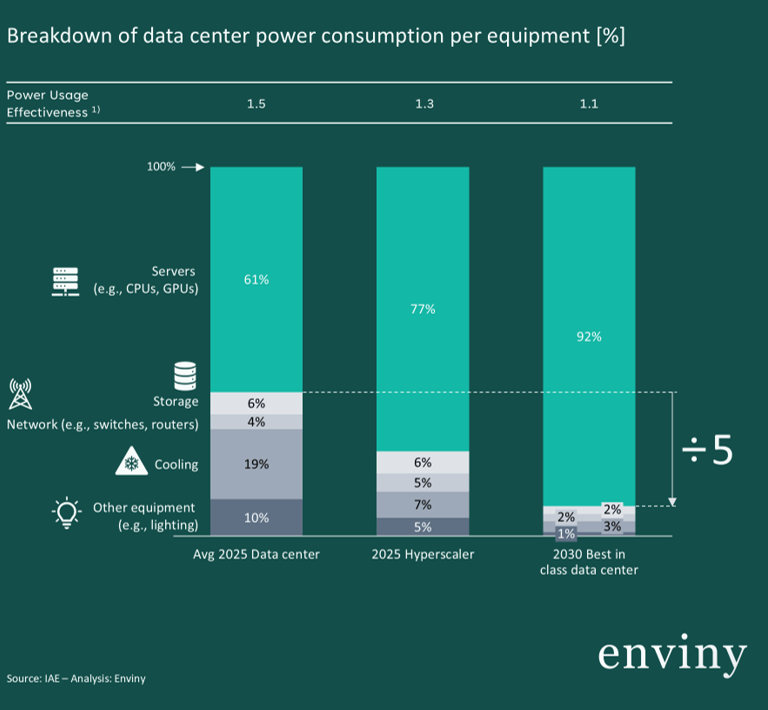
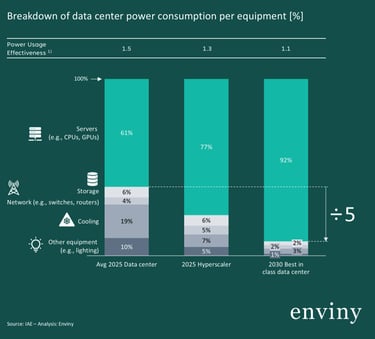
Data center operators are working to reduce non‑core energy consumption and redirect as much power as possible toward computing. To assess how efficiently a facility uses its electricity, the industry relies on Power Usage Effectiveness (PUE). This metric reflects the share of energy consumed by non‑computing infrastructure compared with the total energy used by the data center.
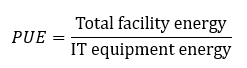
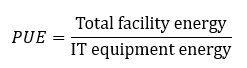
Typical PUE values:
Average data centers: ~1.5
Hyperscalers (AWS, Azure, Google Cloud): ~1.3
Best‑in‑class hyperscale facilities: ~1.1 (enabled by advanced cooling, optimized airflow, and AI‑driven thermal management)
Mega–data centers (in GW or hundreds-of-MW) achieve better PUE through economies of scale, integrated cooling architectures, and optimized power distribution.
New site‑selection criteria are emerging
The increasing size of mega–data centers is introducing new constraints that are fundamentally reshaping Europe’s data center geography. For years, Europe’s data center footprint was concentrated in the FLAP-D markets (Frankfurt, London, Amsterdam, Paris, and Dublin). But several structural shifts are pushing new deployments elsewhere:
Grid constraints — Limited electrical capacity and rising congestion in FLAP‑D make it increasingly difficult to secure the power needed for large‑scale deployments
Land availability & cost — Scarce and expensive land in FLAP‑D restricts the development of multi‑MW campuses and limits future expansion
Power prices — Higher and more volatile electricity prices in FLAP‑D reduce long‑term competitiveness, especially for energy‑intensive AI workloads
Proximity to connectivity hubs — While FLAP‑D remains well connected, saturation and network congestion reduce the relative advantage of staying in these hubs
Access to free cooling — Warmer climates in FLAP‑D prevent operators from leveraging free cooling, making it harder to achieve low PUE compared with Nordic alternatives
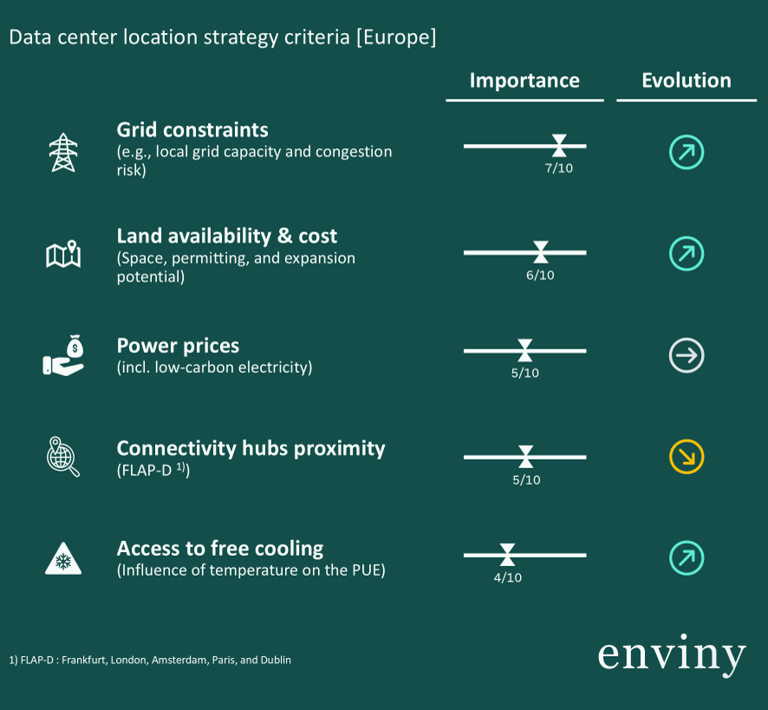
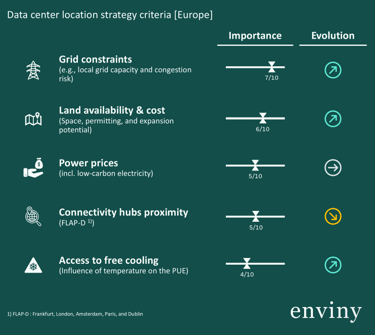
Grid & Cooling constraints reshape EU’s Data Center Map
FLAP‑D will remain central, but capacity growth will increasingly be distributed across other European regions, leading to a more balanced geographic footprint. New hyperscale and AI‑focused facilities increasingly target France, Nordics and Southern Europe for reduced connection delays, low‑carbon and affordable electricity and, in Nordics, free cooling thanks to its cold climate.
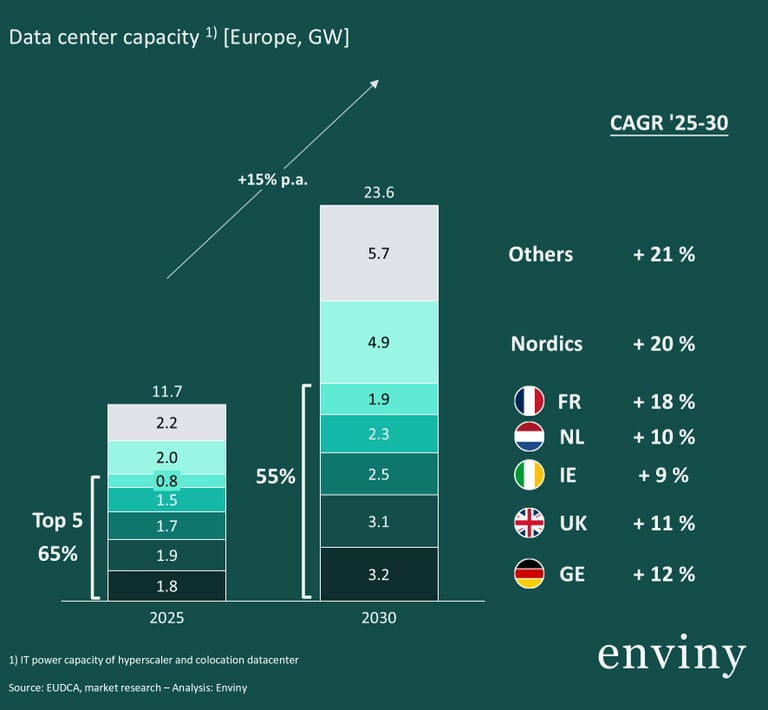
One‑third of data centers will host Behind-The-Meter power in 2030
Data centers are scaling so rapidly that their growing power demand is placing severe pressure on local grids. Many new sites now require dedicated substations or on‑site generation to secure the massive electrical consumption. As these constraints intensify, an increasing number of data‑center operators are turning to behind‑the‑meter solutions to bypass grid bottlenecks, accelerate deployment, and ensure reliable power availability.
By 2030, over one‑third of data‑center facilities are projected to integrate behind‑the‑meter generation or storage assets, driving renewable consumption to 40% - a 3.3‑fold rise versus current penetration.
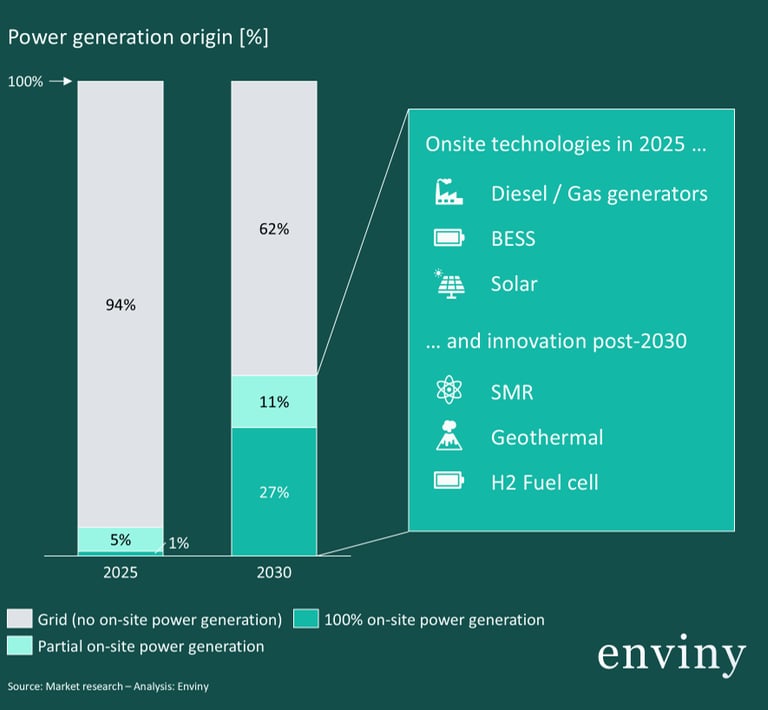
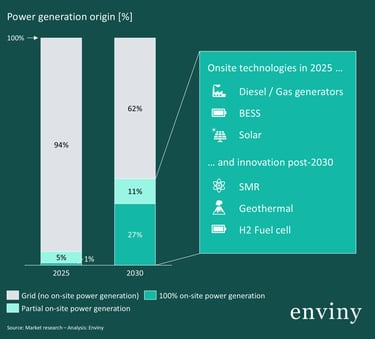
Today, onsite generation technologies still rely heavily on fossil‑fuel power plants:
Gas turbines / gas engines — used for baseload support or backup generation
Diesel generators — primarily for backup
Solar PV + BESS — still limited, notably by land availability, but increasing deployed
Technologies with strong potential through 2030 are:
Large‑scale battery energy storage systems — enabling peak‑shaving, load‑shifting, and grid‑independent operation
Advanced microgrids integrating renewables, storage, and flexible thermal assets — improving resilience and reducing reliance on the grid
Post‑2030 opportunities includes
Small modular nuclear reactors (SMRs) — first commercially viable units expected no earlier than 2030
Geothermal systems in suitable regions — offering stable, low‑carbon baseload potential
Green hydrogen and hydrogen fuel cells — expected to become progressively viable after 2030 as costs decline and supply chains mature
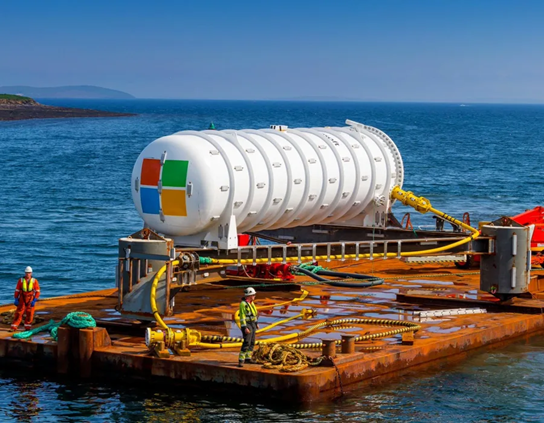
Microsoft’s underwater pilot, Project Natick, in Scotland’s Orkney Islands
Enviny helps investors and operators navigate the energy challenges of the AI infrastructure boom — from site selection and energy sourcing strategies to behind-the-meter renewable integration. Contact us to discuss your data center energy strategy
Related insights
Feeding the AI Boom: Can data centers grow without burning more fossil fuels?
PHEVs get room, but near-100% BEV scenario remains most likely
Automotive transition: The future is electric, but how do we get there?
EU's approach to decarbonizing the automotive sector - What is at stake?
Frequently asked questions
Q : What is driving the doubling of data center electricity consumption by 2030?
Three main forces: the rapid deployment of AI infrastructure (GPU clusters for training and inference), continued growth of cloud computing, and surging demand for video streaming. According to the IEA, global data center electricity consumption will reach approximately 945 TWh by 2030, up from 415 TWh in 2025 — roughly equivalent to Japan's total annual electricity use today
Q : What is PUE (Power Usage Effectiveness) and why does it matter?
PUE measures how efficiently a data center uses energy. A PUE of 1.0 would mean all electricity goes directly to computing — in practice, hyperscalers (AWS, Azure, Google) achieve around 1.3, while best-in-class facilities reach 1.1 through liquid cooling and AI-driven thermal management. Legacy facilities can exceed 1.8. Reducing PUE is the single most impactful lever for cutting a data center's carbon footprint.
Q : Why are data centers moving away from FLAP-D markets (Frankfurt, London, Amsterdam, Paris, Dublin)?
FLAP-D markets are facing structural constraints: electricity grid saturation, soaring land costs, high power prices, and limited scope for free cooling. Operators are increasingly looking at alternative geographies — notably the Nordics (cheap renewable power, natural cooling, stable grids) and France (nuclear baseload, available land, favorable regulation). This shift is accelerating post-2025.
Q : What is behind-the-meter power generation for data centers?
Behind-the-meter means generating electricity on-site, bypassing the public grid. This can involve solar PV with battery storage (BESS), gas turbines (as used by xAI's Colossus facility), or small modular reactors (SMRs) and green hydrogen. Enviny estimates that approximately one third of large-scale data centers will have significant behind-the-meter capacity by 2030.
Q : Can data centers realistically be powered by 100% renewable energy?
Technically yes — but not without careful planning. Matching renewable intermittency to 24/7 data center load requires a combination of long-duration storage, power purchase agreements (PPAs), and grid balancing services. For most operators, the realistic near-term target is 70–90% renewable matching, with firm power covering the rest.